
Pride of Place: On Architecture, Culture and Community
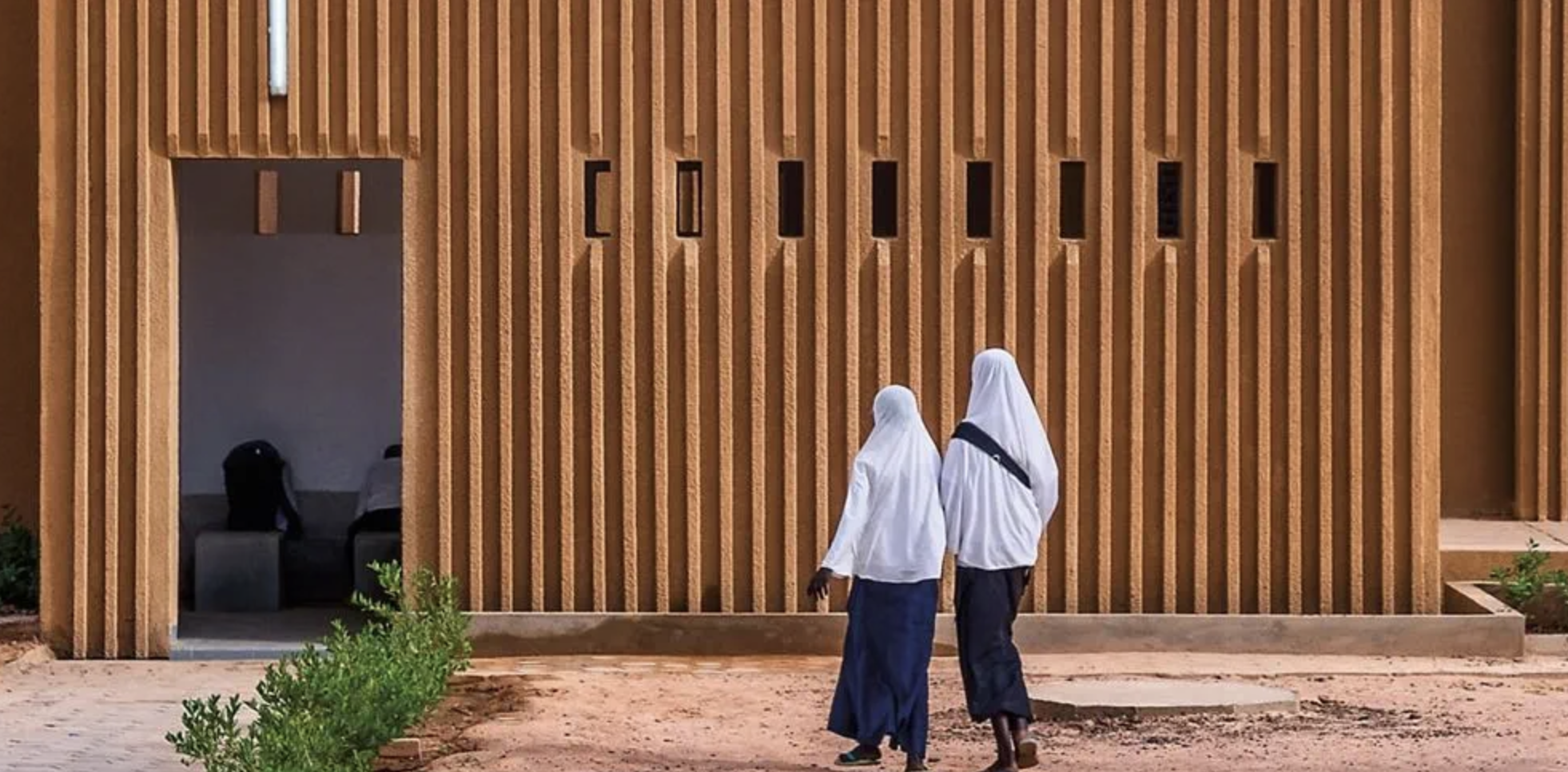
Hikma Community Complex. Designed by Mariam Issoufou and Yasaman Ismaili. Photo: James Wang.
In an interview with Rebecca Anne Proctor of Aramco World magazine, Mariam Issoufou spoke about her childhood growing up near Agadez and how the architecture there influenced her from a young age.
Asked about some of the innovative architectural traditions that she learned while growing up and that still impact her today, Mariam said: “I like to think that I make an architecture that always reflects the place it is for. What began as a more single-minded way to think about Niger and its materials, socioeconomic dynamics, architectural history and narratives has developed into a process of making architecture that I could apply anywhere.
Growing up in Niger, my parents always took us to a village for a month every summer. I always noticed these clay jars at the entrance of a home. They would be in the shade and there would be water inside them. The water from the jars felt as if it had come out of the fridge because the porous nature of the clay cooled and purified the water in the jar, acting as a natural filter.
My first project, Niamey 2000, was a series of homes for low-income families that seeks to balance [population] density with a need for privacy. It led to this intimate exploration of what a home means within a specific context, the desire for privacy but also to have your home feel like an open space that anybody can come to visit. Most of the buildings in Niamey 2000 look orange because in Niger, the soil is orange, and I use earth as a primary material because it is 115 degrees Fahrenheit (46 degrees Celsius). Using concrete is absurd in these conditions because concrete is a conductive material that imprisons heat. I use earth because it drops indoor temperatures by 15 to 20 degrees. This is why it is a local and historically used material.”
Read the rest of the interview.